
| doi:10.3850/978-981-08-6218-3_BUS-We026 |
 Final Paper PDF Final Paper PDF
|
LOAD-BEARING CAPACITY OF PERFORATED TRAPEZOIDAL SHEETING
TH. Misieka and H. Saalb
Versuchsanstalt für Stahl, Holz und Steine, Karlsruhe Institute of Technology, Karlsruhe, Germany.
athomas.misiek@kit.edu
bhelmut.saal@va.uka.de
EXTENDED ABSTRACT
Thin-walled perforated sheeting is used for sound absorption in buildings. The perforation may extend over the whole surface or only parts of the sheeting, e.g. webs. So far only reduction factors for the in-plane stiffness and the bending stiffness of fully perforated sheets with an equilateral triangular perforation pattern are included in EN 1993-1-3 and EN 1999-1-4. The insufficient and misleading formulations of these regulations are overcome by the investigations presented here. Design rules for trapezoidal sheeting which are fully or partly perforated with equilateral triangular or square perforation patterns are given. The design rules take into account the beneficial effect of the post-buckling behaviour of the sheeting. They also cover web crippling at supports or under local loads.
Starting with the basic aspects of the load-bearing behaviour, the parameters kij required for capturing the influence of the perforation are defined and determined for the different perforation patterns. By introducing these parameters into the design, the use of these procedures is expanded to fully perforated structural components.
Based on numerical and experimental investigations on web crippling, it can be shown for fully and partially perforated trapezoidal profiles, that the influence of the perforation can be captured by multiplying the capacities according to EN 1993-1-3 and EN 1999-1-4 with a factor Cp for fully perforated profiles and Ctp for partially perforated profiles. A calculation procedure for these factors is given.
1. STIFFNESS
Reduction factors kij for the stiffness were developed for perforation patterns with a continuous arrangement as equilateral triangle or as a square (Figure 1).
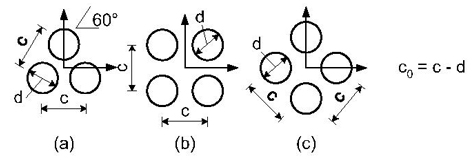
Figure 1: Perforation patterns
2. LOAD-BEARING CAPACITY OF PLANE CROSS-SECTION PARTS
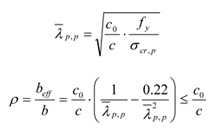
The ideal buckling stress of perforated rectangular plates under constant uniaxial compressive stress is given by σcr,p = kσ,p · σe with the minimum of the effective buckling value
kσ,p=2.[k11+k44+0.3.(k12-k44]
This effective buckling coefficient refers to Euler’s stress σe of the unperforated plate. The slenderness and the effective width beff is determined from
3. WEB CRIPPLING
The equations of EN 1993-1-3 and EN 1999-1-4 for calculating the supporting force for trapezoidal profiles made of steel or made of aluminium respectively can be adjusted by multiplication with a factor Cp for fully perforated trapezoidal profiles or a factor Ctp partially perforated webs.
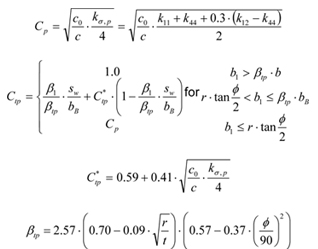
b1 is the width of the unperforated part of the web adjacent to the support. The width of the support bB has to be limited to sw in the equations as well as in the criteria for differentiation.