
| doi:10.3850/978-981-08-6218-3_BUS-Th043 |
 Final Paper PDF Final Paper PDF
|
BEHAVIOUR OF BLIND-BOLTED MOMENT CONNECTION TO A CONCRETE-FILLED CIRCULAR COLUMN
H. Yao1,a, H. M. Goldsworthy1,b and E. F. Gad1,2
1Department of Civil and Environmental Engineering, University of Melbourne, Parkville,Vic 3010,
Australia.
ajacyao@unimelb.edu.au
bhelenmg@unimelb.edu.au
2Faculty of Engineering and Industrial Sciences, Swinburne University of Technology, Hawthorn, Vic
3122, Australia.
EGad@groupwise.swin.edu.au
EXTENDED ABSTRACT
This paper presents the results of an experimental study that investigates the strength and stiffness of a blind-bolted moment connection to a concrete-filled circular column. In this beam-to-column connection, double built-up tees are bolted to the circular hollow section and to the top and bottom flanges of a universal steel beam. In order to limit the out-of-plane deformations of the thin tube wall under tension, cogged extensions are provided to the blind bolts, hence improving the rigidity of the connection. The advantage of this type of moment connection is easy fabrication and installation compared to welded moment connections using external and internal diaphragms. The experimental program is described briefly and key aspects of the results are presented in terms of the moment-rotation relationship, failure mode, and displacement distributions within critical components. A simplified component model is developed to predict the initial stiffness of this blind-bolted moment connection. The joint is divided into basic elements in tension and compression zones which are simulated by individual springs with a defined force-displacement relationship. By assembling the characteristics of individual components, the strength and stiffness of the connection can be determined in a simple way for routine design.
1. INTRODUCTION
Structural frames with concrete-filled circular hollow sections have become popular in multistorey buildings owing to their robust structural performance and aesthetic appearance. However, the advantages are under-exploited due to the perceived difficulties in making connections between steel beams and tubular columns, especially for moment-resisting frames. Field welding the connections with inner, exterior and through diaphragms are the common practice to achieve a moment-resisting connection [1]. Several types of blind fasteners have been developed to overcome the difficulty of accessing the inner side of structural hollow sections, such as Huck high strength blind bolts [2], Lindapter Hollobolt [3], Ajax Oneside [4], and flow drilling method [5].This study is aiming to investigate the performance of a blind bolted moment connection between steel beams and circular composite columns employ on-site bolting.
2. EXPERIMENTAL PROGRAM
The test specimen shown in Figure 1 is representative of exterior beam-to-column joints in a five-storey moment-resisting frame. It was composed of a concrete-filled circular hollow section, two curved T-stubs, and a universal steel beam. The curved T-stubs were fastened to the circular tube by modified blind bolts with cogged extensions into the concrete core. The bind bolt and cog assembly consists of a bolt with circular head, a cog extension to the bolt head, a sleeve for shear, a split stepped washer, and a stepped washer. An axial load of 800 kN was applied to the top of the column and the load applied to the beam end consisted of a series of load controlled cycles followed by a series of displacement controlled cycles. The specimen was fully instrumented with transducers, strain gauges, and photogrammetry targets. The specimen achieved a maximum load of 282 kN at the beam end. It failed due to the fracture of the thin tube wall at the top row of blind bolts at the tension zone. This load is equivalent to an ultimate moment of 606 kNm at the column face. The behaviour of the beam-to-column connection can be represented by a moment-rotation curve shown in Figure 2. The connection can be classified as rigid connection for braced frames and stiff semi-rigid connection for unbraced frames.
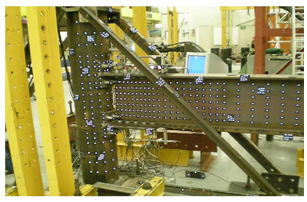 | 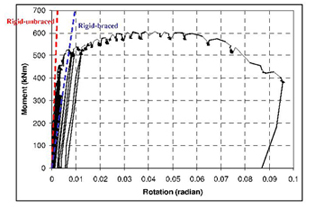 |
Figure 1: Beam-to-column connection | Figure 2: Moment vs. rotation of the connection |
3. ANALYTICAL MODELLING
The blind-bolted moment connection to the circular column can be represented by two series of springs in the tension and compression zones. By assembling the characteristics of individual key components, the strength and stiffness of the connection can be determined in a simple way for routine design.
4. CONCLUSIONS
A full scale test on blind-bolted moment connection to the concrete-filled circular column demonstrates the strength and stiffness which can be utilised in transferring moment between the beam and column within low rise structural frames. Providing a cogged extension to the blind bolts improve the tensile behaviour of the moment connection as the load can be shared between the tube wall and cogged anchorage within the concrete. Based on moment-rotation response of the connection, the proposed blind-bolted connection can be classified as rigid connection for braced frames and stiff semi-rigid connection for unbraced frames. The initial stiffness of the connection can be predicted using a simplified component model.