
| doi:10.3850/978-981-08-6218-3_BUS-Th024 |
 Final Paper PDF Final Paper PDF
|
INTRODUCTION OF TENSILE FORCES IN SANDWICH PANELS WITH MECHANICAL FASTENERS
S. Käppleina, TH. Misiekb, A. Dachevac and TH. Ummenhoferd
Versuchsanstalt für Stahl, Holz und Steine, Karlsruhe Institute of Technology, Karlsruhe, Germany.
asaskia.kaepplein@kit.edu
bthomas.misiek@kit.edu
calbena.dacheva@stud.kit.edu
dthomas.ummenhofer@kit.edu
EXTENDED ABSTRACT
Sandwich panels are made of an insulating core material, covered by two metallic faces. In several applications the need to anchor loads in sandwich panels arises. This is normally done by introducing the load in one face, using mechanical fasteners such as screws or rivets. When introducing tensile forces perpendicular to the surfaces of the panels, failure by delamination, tensile failure of the core or pull-out failure is possible.
To study both, the influence of the edge distance and the effect of repeated loads, experimental tests were performed. These tests allowed to study the effects of different parameters such as material properties of the core, type of fastener (screws, rivets) and edge distance. New types of fasteners allow introducing the load not only into the face material, but also into the core material. These fasteners are forming a thread into the core material. This reduction of load on the bond between core and face significantly reduces the risk of debonding. Experimental tests with selected types of fasteners and core materials were done. The results are presented and some basic considerations required for a design model are introduced.
1. FIXING WITH MECHANICAL FASTENERS
When introducing tensile forces perpendicular to the surfaces of the panels, failure will occur by pull-out failure of the fastener or delamination of the face. Pull-out failure is generally the acceptable failure mode and can be achieved by keeping a minimum edge distance. But if repeated loads such as wind loads are acting on the fasteners, the governing failure mode tends to be delamination. Small cracks in the bond layer grow until final failure of the connection. Screws (self-drilling or self-tapping screws) and rivets can be classified as conventional mechanical fasteners for thin-walled building components such as sandwich panels. Their pullout strength from the faces can be determined. For the presented tests, self-drilling screw fasteners 6,3xL with a reduced pin diameter and triple claw blind rivets were used with several types of sandwich panels.
In nearly every case, failure occurred by pull-out of the fastener, independent of the type of core material and face thickness. Therefore it can be concluded that for usual configurations both of the core strength and the properties of the faces, debonding is not the decisive failure mode, adequate edge distances assumed. For this configuration, the simplified mechanical model shown in Figure 1 can be assumed.
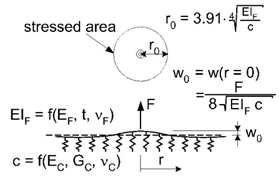
Figure 1: Mechanical model
The stressed area increases with bending stiffness of the face and decreases with flexibility of the face material: A rigid face transfers the load to a larger area, providing a wider load distribution and therefore lower stresses between face and core material. A flexible core leads to high deformations of the face and therefore high stressing of core and bonding. This increases the risk of stripping off of the face. In our case, the relatively low tensile strength of one of the specimens was compensated by the high Young’s modulus.
Tests with repeated loading were performed. For the screw fastener, in every case, an upper load level of 85 % (k = 0,85) of the mean value determined from the static tests could be applied without failure in the cyclic tests, finalised with a residual static strength of the same level as in the purely static tests.
For face sheets with lining, effects of the orthotropy could be observed: Due to the lining a preferential direction in load-distribution arises and the stressed area becomes elliptical instead of circular.
2. DOWELS FOR FIXING IN THE CORE MATERIAL
Several types of dowels designed for fixing in insulation materials were chosen and their applicability tested. All dowels were set only in the core material. In the failure occurred by breaking out of the core. Tests with repeated loading were performed to check whether connections with these dowels can be exposed to repeated wind loads. In every case 5000 load cycles with an upper load level of 50% (k = 0,5) of the mean value of the static resistance could be applied. There was no reduction of the residual pull-out strength compared to the load maximum obtained in the static tests.
The presented research has been done within the framework of the EASIE project. The EASIE project has received financial support from the European Community’s Seventh Framework Programme FP7/NMP2-SE-2008 under grant agreement No 213302.