| doi:10.3850/978-981-08-6218-3_BUS-Th007 |
 Final Paper PDF Final Paper PDF
|
EXPERIMENTAL STUDY ON THE FLEXURAL BEHAVIOR OF HIGH-STRENGTH SQUARE CFT MEMBERS
KS. Chung1,a, WJ. Kim2,c, SB. Hong2,d and JH. Kim1,b
1Architecture & Offshore Research Div, RIST, Hwaseong, Korea.
akschung@rist.re.kr
bjinho@rist.re.kr
2R&D Center, POSCO E&&C, Hwaseong, Korea.
ckimwj@poscoenc.com
dsbhongs@poscoenc.com
EXTENDED ABSTRACT
Experimental data for square CFT columns made from high-strength steel (Fy>550MPa) and high strength concrete (fck>100MPa) under loading is lacking. Therefore, the behaviour of square concrete-filled steel tube members made from high-strength materials was investigated experimentally. Six full scale CFT specimens were tested cyclically. The primary test parameter was material strength. The effect of yield stress of the steel tube and compressive strength of the filled concrete on the stiffness, load-carrying capacity of high-strength CFT members was studied.
TEST AND RESULT
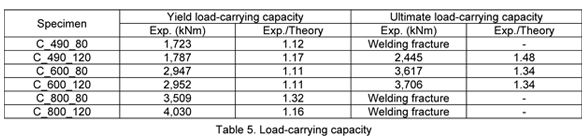
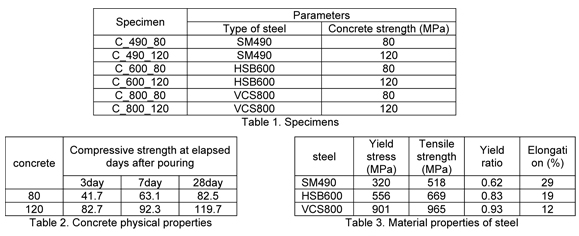
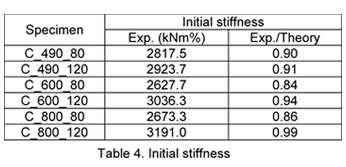
Figure 1 shows the details and dimensions of the tested high strength CFT members. The experimental set-up for square CFT member subjected to bending moment is shown in Figure 2. The test specimens were listed in Table 1 to investigate bending behaviour of CFT by using high strength steel tubes and concrete. Variables parameters were concrete compressive strength (80MPa and 120MPa) and steel yield strength (320MPa, 555MPa and 900MPa). The basic material properties observed for each CFT steel tube are listed in Table 2 and Table 3. The moment-rotation curve is shown in Figure 2. Predicted initial stiffness of the composite members based on the code provisions is compared with the current experimental results in Table 4. Results in this table clearly show that for members with high strength material, calculated stiffness gives the initial section stiffness about 16% ~ 1% higher than those of the tests. The yield load-carrying capacity (My) of composite member is evaluated based on deformation compatibility using the KBC 2009. In comparison between test and theory, the calculated yield load-carrying capacities are about 11%~32% lower than those of test results regardless of material strength, so it was safety to use this method. The ultimate load-carrying capacity is calculated by general cumulative strength based on Fy and 0.85fck. Here, Fy is the yield strength of steel tube and fck is the compressive strength of concrete. Shown in Table 5, the predicted ultimate load-carrying capacities are about 34~48% lower than those of test results.
CONCLUSION
This paper mainly deals with the static behaviour of square CFT members with high-strength materials. Based on the investigations above, it can be concluded that the structural behaviour can be conservatively predicted from the design provisions in the current KBC 2009 code.
ACKNOWLAGEMENT
This projects was sponsored by the Grant from High-Tech Urban Development Program (09CHUD-A052272-01) funded by the Ministry of land, transport and maritime affairs.
REFERENCES
Architectural Institute of Korea, Korean building code and commentary. AIK 2009.
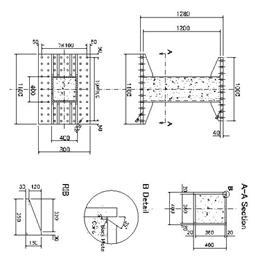 | 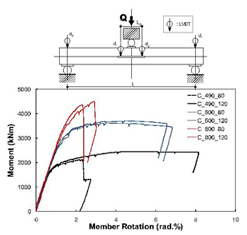 |
Figure 1: Configuration of Specimens | Figure 2: Moment-rotation relation |
 | 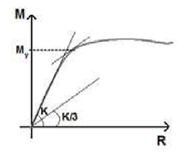 Figure 3: Definition of yield capacity |