
| doi:10.3850/978-981-08-6218-3_BS-We027 |
 Final Paper PDF Final Paper PDF
|
SOIL-STRUCTURE INTERACTION OF COMPOSITE BRIDGES WITH INTEGRAL ABUTMENTS
D. Paka and M. Feldmannb
Institute for Steel Structures, RWTH Aachen University, Aachen, Germany.
apak@stb.rwth-aachen.de
bfeldmann@stb.rwth-aachen.de
EXTENDED ABSTRACT
For bridges, sustainability, maintenance and durability become more and more important. Therefore integral abutment bridges turn out to become highly attractive to designers, constructors and road administrations. The main reason for this is that they tend to be less expensive to build, easier to maintain and more economical to own over their life time. This is principally due to the non-existence of bearings and joints that are main sources of maintenance costs during life time. However, in most European countries only few experiences with integral bridges have been gained so far. Therefore two European RFCSprojects have been launched in 2005 and 2009 on which this contribution is based. Within the scope of these projects experts worked together to develop economic and safe solutions for composite bridges with integral abutments.
1. DESIGN OF INTEGRAL ABUTMENT BRIDGES
As the abutments are connected monolithically to the superstructure, the concept as well as the design of bridges with integral abutments differ in some aspects from the design of conventional bridges with bearings and joints. Regarding the design procedure according to national as well as international codes, a lack of rules and specifications in view of the soilstructure interaction can be detected. Therefore this paper presents a closed design procedure, showing designers and authorities how to consider the soil surrounding foundation piles as well as the backfill beyond the integral abutment.
2. CONSIDERATION OF SOIL SURROUNDING PILES
For the elastic bedding of foundation piles, the soil surrounding the piles is represented by linear springs. The possible distribution of spring constants over the depth is brought down to two cases (loose / dense soil), which are considered separately, see Figure 1.
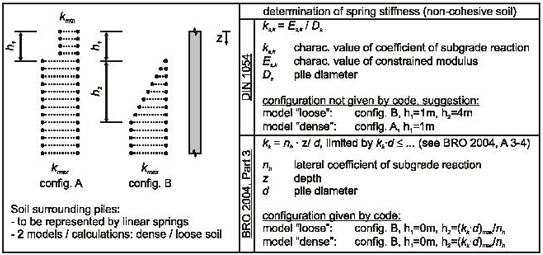
Figure 1: Application of springs behind piles acc. to DIN 1054 / BRO 2004, Part 3
3. CONSIDERATION OF BACKFILL
To take into consideration the backfill behind the abutment, the soil is represented by an external loading, which is combined with the conventional temperature load cases. Here it has to be distinguished between a winter and a summer case, which are based on active and mobilised passive earth pressure respectively. Furthermore a permanent load case, representing the at rest condition of the backfill, needs to be applied, see Figure 2.
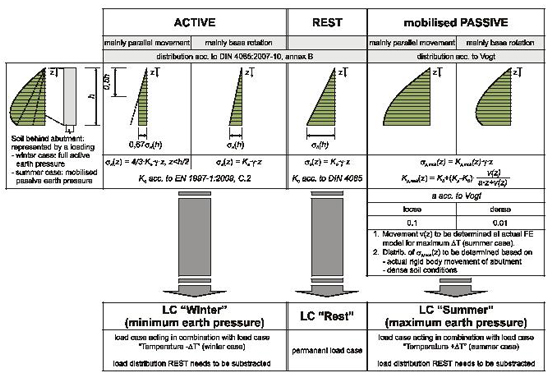
Figure 2: Load case determination “soil” for bridges with integral abutments