
| doi:10.3850/978-981-08-6218-3_BS-We002 |
 Final Paper PDF Final Paper PDF
|
AN INNOVATIVE HYSTERETICAL STEEL DEVICE FOR THE IMPROVEMENT OF SEISMIC PERFORMANCE OF FRAMED R.C. STRUCTURES
L. Ananiaa and A. Badalàb
Department of Civil and Environmental Engineering, University of Catania, Italy.
alanania@dica.unict.it
babadala@dica.unict.it
Nowadays, the seismic retrofitting of buildings, is carried out by manipulating some of the bearing elements of the structure in order to obtain a higher seismic resistance by means of an increment of the structural stiffness as well as that of the dissipative capacities. This, represents the wide-spread concept of structural design based on the ductility or on the dissipation achieved throughout the plastic hinges formation following to a seismic event of high intensity. In fact, great relative displacements, between different floors, produce so much damage that plastic zones occur and subsequently, some very expensive operations have to be undertaken for the seismic rehabilitation after a destructive event. But a conceptually more attractive solution is the insertion in the structural braced system of special devices capable of dissipating controlled quantity of the energy transmitted by the earthquake and to reduce the global response in order to avoid the collapse or the damage of the main structure. Such composite system is called “ADAS” (added damping and stiffness), because of the use the hysteretical devices capable of sustaining great deformations and of concentring inside the plasticization even after numerous destructive seismic cycles, leaving the main structure in elastic domain, then they can be easily replaced.
In the past years the authors had designed a new hysteretical device whose shape was capable of guaranteeing a uniform plasticitation for simple bending moment. This device gives some advantages in terms of both cheap and simple manufacturing, due to a non-calibrated shape, as well as in terms of stability of the hysteretical loops even after a very high number of cycles. The theoretical and the experimental research carried out until now have regarded only the study either of the single device or its performance when inserted in a single mesh of a framed structure. In this paper, this investigation was extended to a multy-storey frame. That frame has been previously studied by means of both a push over investigation and a dynamic analysis. Then three different distributions of the proposed hysteretical devices were considered in order to better evaluate the improvement due to the employment of such hystertical devices whose behaviour was studied under El Centro, San Fernardo and Kern opportunely amplified accelerograms.
A parametric investigation was also carried out with the aim of evaluating the right disposition, the number of the devices to employ as well as their dimensions inside a real three dimensions framed building in order to obtain the best performance in terms of structural response.
Two more non-linear dynamic analysis were carried out in order to evaluate the efficiency of the protection system realised by means of the hystertical device designed and tested by the same authors and dimensioned by applying the coefficient equal to 0,8 at the ratio S* between the yielding shear force of the device and the shear force at each storey. Namely we referred also this time to the previous acelerograms of El Centro, Kern and San Fernando but the PGA this time was that deduced by the rules in yielding condition and at the ultimate state for seismic zones. Not only the floor displacement at elastic limit was controlled , but also the reduction of the damage.
The analysis have given us the following diagrams. From the comparison between Figure 1 and Figure 2, it can be noted that the activity concerned had caused and excess of the elastic limit at the fifth storey in the original frame for the accelerograms of El Centro, while in any case, the 0,001h limit to which we can associate the damaging of the non structural parts at all levels, has been surpassed. In the frame with seismic protection system with steel elastic-plastic dissipators, the structural elastic threshold has been never surpassed for the all accelerograms, while only the El Centro one showed non-structural damage at levels 2-6.
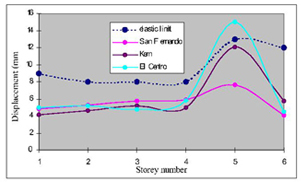 | 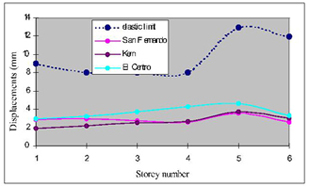 |
Figure 1: Original frame PGA 0.07 | Figure 2: Protected frame PGA 0.07 |
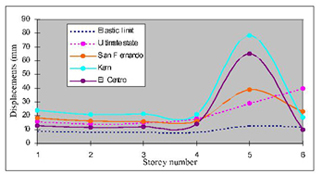 | 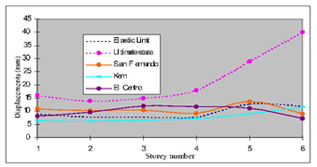 |
Figure 3: Original frame PGA 0.25 | Figure 4: Protected frame PGA 0.25 |
In this plots we can also note that in the original frame the displacement to the elastic limit is practically always surpassed, while the last displacement, assumed to be definite, is surpassed in two third of the cases. Moreover, the displacement of the fifth level for the earthquake according to Kern and El Centro, greatly exceeds the displacements associated to the ultimate state for all the storeys (Figure 3), and so it is necessary to form a storey mechanism. In the frame seismically protected by the proposed devices, the analysis conducted for a PGA = 0,25g (Figure 4), never causes the achievement of the collapse displacement. Besides, even the elastic limit is surpassed in the 50 % of the cases The study permits us to state, that, in the case concerned, the adjustment with the proposed seismic devices assures the survival of the main structure in the case of ultimate state and protects from any structural damage during life condition. The advantage of the proposed device consists both in its easy realization and in the possibility of series coupling more devices in order to cover the structural requirements.