
| doi:10.3850/978-981-08-6218-3_BS-We001 |
 Final Paper PDF Final Paper PDF
|
PREFABRICATED COMPOSITE TIMBER BRIDGE DECK WITH STEEL SHEAR CONNECTORS
C. Adama and H. Milnerb
Department of Civil Engineering, Monash University, Melbourne, Victoria.
acon.adam@eng.monash.edu.au
bbob.milner@eng.monash.edu.au
EXTENDED ABSTRACT
The paper describes an all-timber, prefabricated, composite acting bridge deck that has been developed at Monash University, Melbourne, Australia that outperforms other beam type timber bridge decks by virtue of the fact that it utilizes composite action between the decking and stringers. The deck on which current developments have been based employs three round log stringers per 3.2 m span design lane of diameter no more than 500 mm and Bridgewood decking, a thick plywood. The composite action enables bridge decks to be constructed with considerably smaller stringers than has been possible previously. The deck modules are prefabricated full span length and can be as wide as can be transported within legal limits without special escort vehicles. The modules are joined on-site on a bevelled edge using grouted rod type technology. Other details included are aspects of the method of fabrication, the shear connectors employed, the linear and non-linear finite element analyses used to investigate the deck performance and the results of tests on a mixed scale model used to validate the finite element analysis.
The type of bridge proposed in this paper comprise of 3 stringer deck with a composite acting heavy plywood decking and it is not a type that is readily conceivable without the development of heavy plywood decking of up to 170mm thick, known as Bridgewood in Australia. Old growth, high strength, durable eucalypts are well suited to bridge construction, but the unavailability of this timber has resulted in many bridges falling into a state of disrepair. Australian eucalypts, such as Grey Box, Black Butt and Iron Bark are classified in Australian Standard AS1720.1 are described as having so-called F27 or better strength properties (80MPa lower 5th percentile strength and mean modulus of elasticity 18500MPa) and high durability ratings. Under current circumstances log sizes of 500 mm or less are all that are readily available and this imposes constraints on the spanning capabilities with conventional spiked decking construction. What motivated this investigation was to determine if, in fact, it was possible to invoke composite action between the beams and decking and achieve a significant benefit. The Bridgewood decking was considered as a logical choice given the flexibility it provides in sharing its stiffness in the longitudinal and lateral directions. thus controlling the modulus of elasticity parallel or perpendicular to the longitudinal axis of the bridge, and confers a number of other advantages including:
- reduction in stringer size compared to a non-composite acting deck,
- modular construction, prefabrication possible, which minimizes on site work and road closure times,
- very light weight so they can be used on existing substructures without overloading them, capacity o carry M1600 loads, over spans up to 12m,
- no prestressing required and thus no on-going problems with its maintenance,
- good weather-proofing brought about by the protection offered by the CCA treated Bridgewood decking.
A trial design of a single lane, 12 m span prototype bridge was prepared using M1600 loading. Bending moment and shear force envelopes were developed indicating that a live load bending moment capacity of 2870 kNm over a 3.2 m wide traffic lane was required purely to meet strength limit state requirements under a live load 1.25G + (1.8 x 1.3)Q; safety factor on live load = 1.8, impact factor taken = 1.3. With φ500 mm stringers over a 3.2 m standard design lane and 166 mm thick Bridgewood decking and assuming full composite action between deck and stringers, a bending moment capacity of approximately 3500 kNm is achievable. The limit is imposed by the relatively conservative assumption that the stringers will fail in tension on the lower face at f'b=50MPa. Under loading of 1.3Q the span/deflection ratio is 380, average Estringer = 25 GPa. This deflection is somewhat in excess of that normally permitted in bridges (span/deflection ≤ 600). Increasing stringer diameter to between 550 and 600 mm overcomes the problem at the expense of having to source larger diameter stringers. There is a less acute problem with shorter span bridges. Other methods of overcoming this problem are theoretically possible but have not been confirmed experimentally.
The model bridge supported an ultimate load of 696 kN which corresponds to a prototype load of 696/0.37 = 1881 kN. The requirement is 360 x 1.8 x 1.3 = 842 kN indicates that the bridge has more than adequate strength as might be expected of a material having a higher strength to weight ratio than either the majority of steels and concrete. Failure involved simultaneous crushing of the deck in the longitudinal direction and tension failure in the western stringer. The measured deflections of the bridge under test are shown in the Figure below along with the serviceability load.
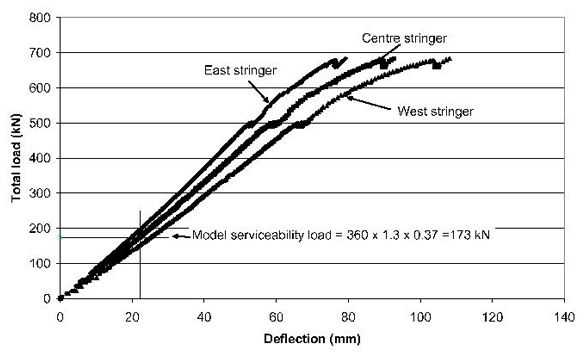
Timber bridges of other than the truss type continue to offer many advantages not available from other bridge types. The development of composite action brought about with the use of glued-in rod technology provides a cost effective method of constructing all-timber, composite acting bridge decks. Timber bridges of span 12 m and of the design investigated in this project (span/deflection ≈ 380) tend to be more flexible than is normally considered desirable in bridge design.