
| doi:10.3850/978-981-08-6218-3_BS-Th039 |
 Final Paper PDF Final Paper PDF
|
FATIGUE BEHAVIOUR OF STEEL BRIDGES
Sh. Urushadzea, L. Frýbab, M. Škaloudc and M. Zörnerovád
Institute of Theoretical and Applied Mechanics, v.v.i., Academy of Sciences of the Czech Republic,
Prosecka 76, CZ 190 00 Prague 9, Czech Republic.
aurushadze@itam.cas.cz
bfryba@itam.cas.cz
cskaloud@itam.cas.cz
dzornerova@itam.cas.cz
EXTENDED ABSTRACT
An investigation into the performance of orthotropic deck details encountered in steel bridge structures subjected to static and many times repeated loads, several theoretical and experimental methods being applied in the solution. The experiments involved in the investigation are focused on crack propagation, stress concentrations and the fatigue life of the whole girders. As far as the results obtained are concerned, it was found out for example that the most vulnerable detail appeared to be the spatial connection of the deck with cross beams and longitudinal ribs, where a pronounced concentration of stresses occurred. Orthotropic decks are progressive structural elements which often appear in civil, mechanical, ship, air and space engineering. They suffer from dynamic forces causing the fatigue cracks. Therefore, we have tried to improve their fatigue properties and, thus, to prolong their life. It has shown that the Carbon Fibre Reinforcement Composites (CFRC) glued in the critical details of the deck succeed to prolong the fatigue life of the decks.
The other research project studies the fatigue behaviour of steel plate girders whose webs repeatedly buckle (“breathe”) under many times repeated loads. The main tool of the investigation is an application of numerous experiments carried out on steel thin-walled girders the webs of which are under the action of many times repeated combined shear and bending, which is the kind of loading most frequently encountered in bridge girders. The initiation and propagation of fatigue cracks, generated during the cumulative damage process involved, and their impact on the failure mechanism, the fatigue limit state and the fatigue life of the girders are studied
1. STATIC AND DYNAMIC TESTS ON ORTHOTROPIC DECK DETAILS
The dimensions and forces of the specimens in the series A for the programme described above can be seen in the Figure 1. They have to correspond to the form and dimensions of real bridges (both highway and railway) as well as to the dimensions and force possibilities of the laboratory.. Up to now 9 specimens have been tested.
The specimens were cycled in the machine MTS with frequency 2 Hz. The cycling process provides a sinusoidal form under a minimum force Fmin and maximum force Fmax. The minimum force was held constant Fmin= 10 kN, while the maximum force Fmax was changed from case to case to receive the Wöhler line.
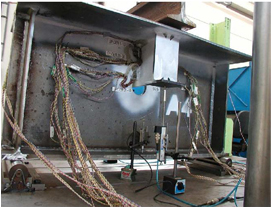 | 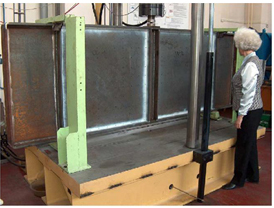 |
Figure 1: The specimen of type A | Figure 2: One of the test girders in the testing position |
2. WEB BREATHING
The plate elements, for example, the webs of steel bridge structures, are subjected to many times repeated loading and therefore repeatedly buckle out of their plane Figure 2, this phenomenon being usually termed “breathing”. The breathing phenomenon then generates a pronounced cumulative damage process in the girder, which substantially influences its limit state. As a suitably designed experimental investigation can be regarded as an ideal tool for studying this complex problem, an extensive series of such tests was started in Prague several years ago (see the figure enclosed).
Within its framework two types of girders were tested, their loading being such that the web panels under consideration were subjected to many times repeated combined shear and bending with the effect of shear predominating. It was found out that the main impact of the cumulative damage process in the breathing webs was the initiation and propagation of fatigue cracks. They developed in crack-prone areas, which in this case was at the toes of the fillet welds connecting the flanges and transverse stiffeners with the web sheet. Just in part of the test girders only one fatigue crack initiated, at first advancing along the fillet weld and then (in most cases) turning inside the web and perpendicularly to the tension diagonal. In other cases two or more fatigue cracks developed. But whatever their system, their growth was a stable phenomenon with no abrupt change in the rate of crack propagation. Never during our experiments did we observe a kind of the critical lengths phenomenon known from Fracture Mechanics. All of the test girders collapsed earlier, when the fatigue crack (or cracks) were long enough to generate the failure mechanism of the whole girder; i.e. when the fatigue crack cut most of the tension band in the buckled web, the girders behaved, and failed, like ones having a large opening in the webs.
3. ACKNOWLEDGEMENT
The supports of the team solving the problem BRIFAG as well as of the financing from the Research Fund for Coal and Steel (RFCS) of the European Commission (EC), granted under the contract Nr. RFSR-CT-2008-00033 are acknowledged.